
The BassFishin.Com Line Guide
Knowing what size and type line to use for different baits is critical.
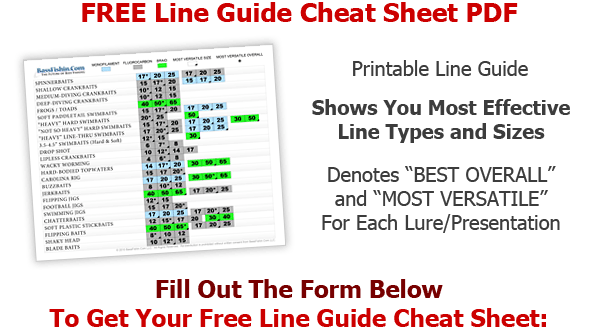
To be the best fisherman you can be, you have to know which tools are right for the job. The BassFishin.Com Line Guide sets out to provide you with the most effective fishing line choices for various lures and techniques. In this guide, we consider monofilaments, braids, and the latest generation of fishing lines, fluorocarbons. All three line types are distinctly different and have their own unique pro’s and con’s. If chosen properly for your presentation, you will see noticeable gains in your success on the water.
While you will see various line choices for each lure or presentation, this Line Guide is meant to be very specific so you can purchase and spool your reels with the most effective line for the baits you wish to fish. This guide is also very handy for those anglers who have few rods, as you can easily see the possible combinations of line that you can spool up that will give you the greatest versatility for the presentations you foresee yourself fishing the most often in your bodies of water. While versatility is important, The BassFishin.Com Line Guide was created to convey the importance of getting line selection right and the big impact proper line choice can have in putting more fish in the boat. It makes a BIG difference.
How To Use The Line Guide:
For each lure or rig, you will see the suggested line options for the most effective presentation. Some baits have very specific recommendations, while others have many options that are acceptable under various conditions. We do our best to explain the differences in line options for such lures. You will find any helpful notes or frequently asked questions in the box underneath the line recommendations. Use this Guide before you spool up your reels or when you are purchasing your line to help you make the best decisions.
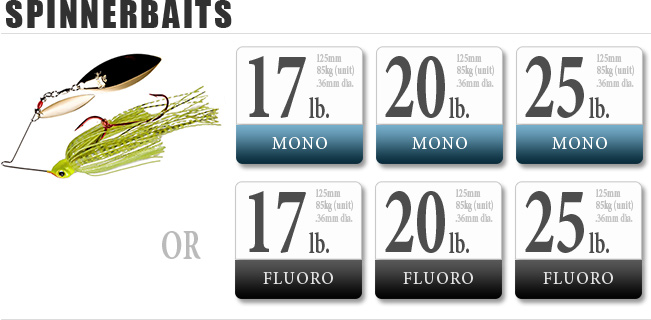
Should I Go With Fluorocarbon or Mono?
There is currently a debate as to which of the two lines is better for spinnerbaits. Some anglers, like Kevin VanDam, favor monofilament because of its buoyancy. Because mono floats, you can keep the spinnerbait closer to the surface more easily, especially on long casts. It is often important to keep a spinnerbait near the surface so fish can’t get a good look at the lure, and mono allows you to do this easily.
Other anglers, like Skeet Reese, prefer fluorocarbon over mono when fishing spinnerbaits because of its enhanced sensitivity, lower stretch and greater invisibility. The common drawback of fishing spinnerbaits on fluorocarbon is you are often required to use a “high tip” to keep the spinnerbait close to the surface. A “high tip” is not the ideal rod position for setting the hook, and thus why many anglers favor monofilament.
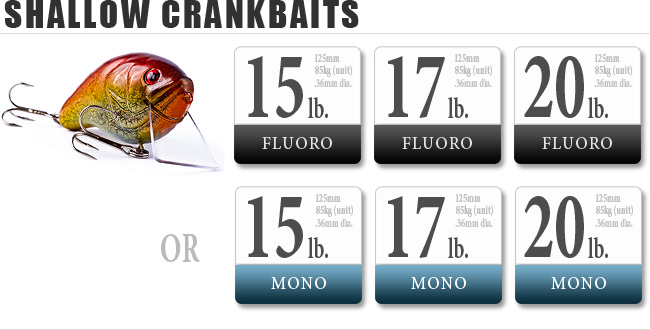
Why Is Fluorocarbon Preferred Here?
The three big advantages fluorocarbon has for shallow cranking is greater abrasion-resistance, lower-stretch and it is much less visible to fish. Because shallow crankbaits are generally fished through heavier cover, fluorocarbon will resist abrasion much more than mono. Because it is low-stretch, you’ll feel more bites and feel the crankbait coming through cover better. A portion of anglers, including some top pro’s, prefer monofilament for various reasons when shallow cranking. One of these reasons is mono’s high-stretch, which will allow you to “pop” or “bowstring” your lure out of snags more often. Besides this reason, there isn’t much else that should sway you away from using fluorocarbon.
Why such heavy lines?
Shallow cranking is mostly done in heavy cover or snaggy environments. You’ll be pulling your crankbait through brush, stumps, and so on. Your line needs to stand up to the abuse and give you the strength to get fish in amongst heavy cover.
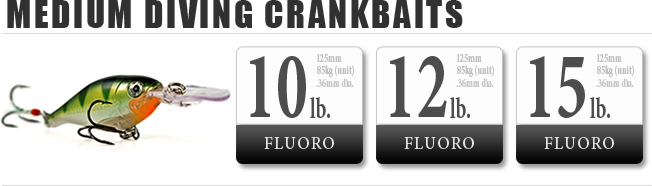
I thought mono was better because it stretched?
Monofilament was long used for crankbaits because it stretched and helped not pull the trebles out of the fish’s mouth on hooksets and fish fighting. While this was certainly a benefit, most anglers these days know that using a medium-action rod (or composite cranking rod) with a soft tip will give the fish the play it needs to not pull the hooks out. With the proper rod, you can get away with the low-stretch that Fluorocarbon exhibits.
The “sink” factor:
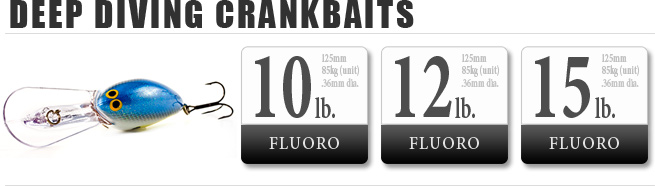
Besides the “invisibility” factor, fluorocarbon sinks and will make your crankbaits run 1-3+ feet deeper than with monofilament. This is a massive benefit. Fluorocarbon is some of the most abrasion-resistant line on the market as well, so working baits around rocks, zebra mussels, etc. is good with this line.
I thought mono was better because it stretched?
Monofilament was long used for crankbaits because it stretched and helped not pull the trebles out of the fish’s mouth on hooksets and fish fighting. While this was certainly a benefit, most anglers these days know that using a medium-action rod (or composite cranking rod) with a soft tip will give the fish the play it needs to not pull the hooks out. With the proper rod, you can get away with the low-stretch that Fluorocarbon exhibits.
The “sink” factor:
Besides the “invisibility” factor, fluorocarbon sinks and will make your crankbaits run 1-3+ feet deeper than with monofilament. This is a massive benefit. Fluorocarbon is some of the most abrasion-resistant line on the market as well, so working baits around rocks, zebra mussels, etc. is good with this line.
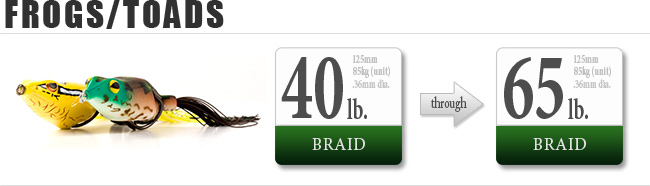
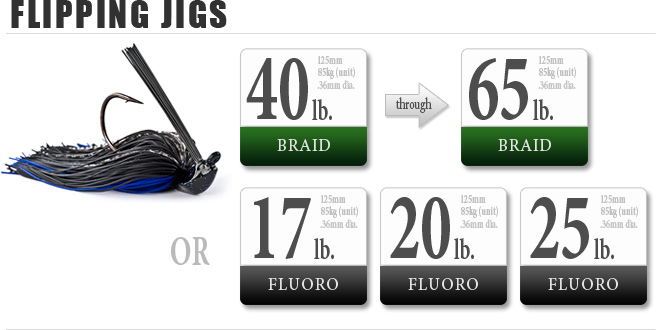
Should I go with 40 or 65? Or somewhere in between?
We at BassFishin.Com strongly suggest focusing your frog and toad fishing at 50 lb test. We like 40 lb test for when you need to make super long casts to cover relatively sparse weedbeds that don’t pose much threat to losing fish. The smaller diameter will add a couple extra feet to your casts which will let you cover a lot more water. Use 65 when fishing closer wood or docks. 50 lb test is the ultimate in-between size that will work just about everywhere and in any situation.
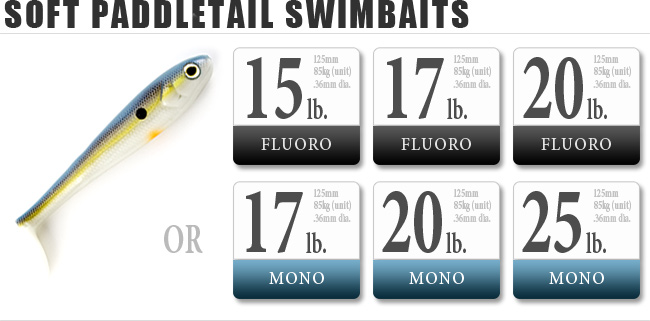
When Fluorocarbon is the best choice:
Fluorocarbon should be your starting point for most bodies of water and presentations. It’s invisibility and low-stretch gives you the edge you need over mono.
So when should I use mono?
Mono is very buoyant and thus is great for when you want to work the swimbait right up near the surface. Mono also has a lot of stretch, which can be put to your advantage if the fish are being finicky and not slamming the lure when they bite. Often times bass will push the bait or be slow to fully engulf these large swimbaits, and monofilament gives you the extra time you need to let the fish get it in it’s mouth before you set the hook. You need to give them a second before setting the hook, and mono ensures you don’t pull it from them too quickly.
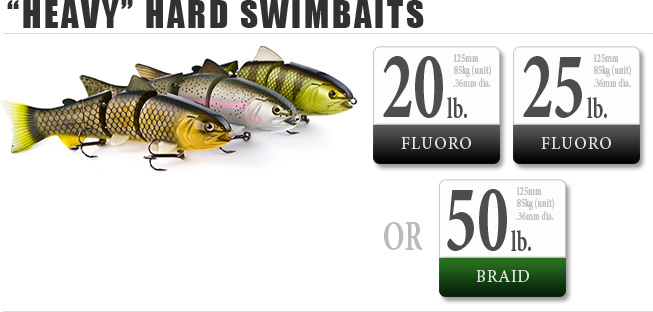
Why we like fluorocarbon better than braid:
Besides its low-visibility, fluorocarbon does have some stretch to it and will prevent you from snapping your line when casting these very heavy baits. Oftentimes when casting these heavy lures with braid, the spool will suddenly stop in mid-cast because the line coming off the reel snags the level-wind, is dug into itself at a certain point, doesn’t “jump” a high spot on the line quick enough, and so forth, causing the line to snap instantly and your $50 swimbait to fly off into the trees or water. It snaps because there is no stretch and 50 lb test line is no match for that sudden shock.
Fluorocarbon on the other hand won’t do this nearly as often, because it has some give to it. So if your line does come to a screeching halt in mid-cast, usually the bait will come to a halt with it and not fly off to never be fished again.
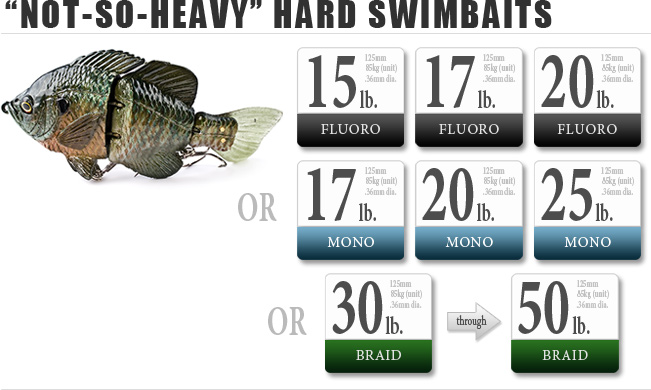
The Type of Line To Use Depends On Stuff…
Fluorocarbon is without a doubt the most versatile of the line types for the “Not So Heavy” hard and soft swimbaits and should be used in most circumstances except one, floating swimbaits! Since fluorocarbon sinks, it is often not a good choice for floating swimbaits. In this case, monofilament (which is buoyant) is a better choice. And with the right rod (softer tip), you can get away with braid even for those floating baits. We should note that there are a couple floating swimbaits on the market that actually perform better with fluorocarbon, but these are the exception, not the norm.
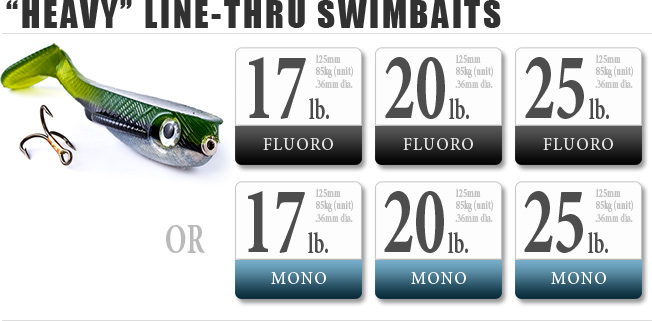
So Do I Choose Fluorocarbon or Mono?
For most applications, line-through swimbaits should be fished on fluorocarbon line. The reason you may want to use monofilament is two-fold. The first reason to use mono is lure depth. Since mono is buoyant, it can help keep a heavy swimbait near the surface. You can slow the swimbait down even more without having it sink deeper. Another possible advantage to mono is when fishing for smallmouth. Oftentimes, smallmouth will strike a lure with their mouths closed to kill it first before engulfing it whole. With mono, your reaction time to setting the hook is slightly delayed because of the stretch and thus you can sometimes have a better hook-up ratio with smallmouth bass by using mono in this circumstance. Other than these reasons, fluorocarbon is preferred and you should control your depth via insert weights, line size and/or retrieve speed.
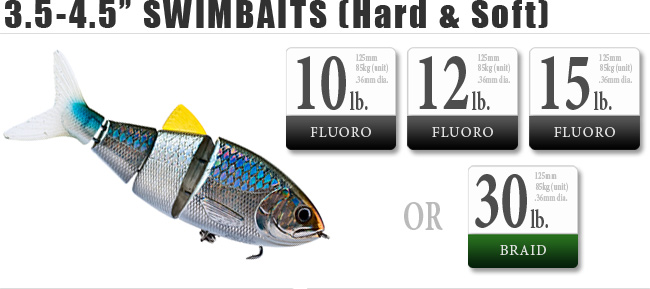
Don’t some pro’s use mono for these?
Some swimbait aficionados prefer monofilament with these smaller swimbaits because of the stretch and claimed “better handling”. A few say monofilament gives these baits better action because it’s more limp. Also, many swimbait sink rates are metered to monofilament, so take that into consideration when using a different type line with different sink characteristics. We feel 12 lb. fluorocarbon is the most versatile choice for these smaller-sized swimbaits. Fluorocarbon offers low-visibility and greater abrasion-resistance.
When Would I Use Braid?
You want to use braid for your floating baits in this category of swimbaits. Since they are smaller baits and most of your 30 lb test line is out of the water, you can get away with braid in nearly any water clarity. Fluorocarbon gets the nod for any non-floating swimbaits of these sizes (hard and soft).
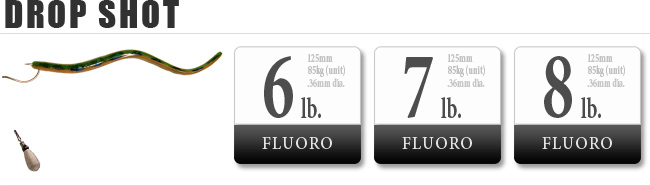
Whoa!?! 7 lb. test fluorocarbon?? Who makes that?
Sunline makes a couple of fluorocarbon lines offering the currently rare 7lb test. Check out their Shooter and FC Sniper Fluorocarbon lines. Drop Shot aficionado Aaron Martens really likes the Sunline 7lb lines for drop shotting because it’s not as weak as 6lb test, but doesn’t dampen the action of the bait as much as 8 lb. It’s a good “in-between”.
Don’t Be Afraid of Even Heavier Line
If the water is a bit stained or you’re dealing with heavy cover, bedding bass, etc, don’t be afraid to try 10, 12 or even 15 lb test. You do sacrifice some lure action with the heavier line, but there are sometimes circumstances that require heavier lines, and in those cases, don’t be afraid to go heavy.
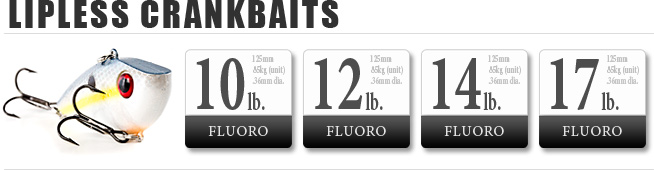
Don’t I need braid for ripping it free of grass?
In thick enough grass, you can get away with using braid and it will work well, however in most cases, fluorocarbon is the better choice because it still has low enough stretch to rip it free of weeds, but still some give if a big fish makes a run at the boat. Again, it’s invisibility is a big plus as well.
Big Range of Sizes There.. Which Do I Choose?
The size line you choose should depend on the depth at which you wish to fish. If you’re fishing shallow (say 5 feet), then lean towards a heavier line. If you are fishing deep (15+ feet), then lean towards lighter line, which will let you keep the bait down in the water column easier.
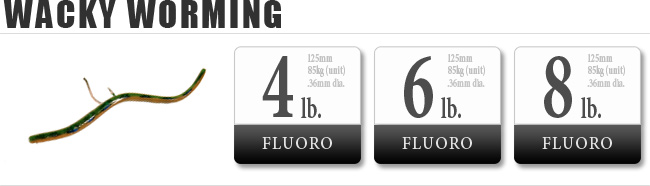
Should I assume 6 lb. is the “all-purpose” choice here?
Definitely. The wacky worm is a finesse technique that’s often used when bass are being finicky or when fishing pressure is at its highest. In light cover, 4 lb can really get a lot of bites. Go with 8 lb. if you’re in thick cover. But absolutely, 6 lb is your all-purpose line size for wacky worming.
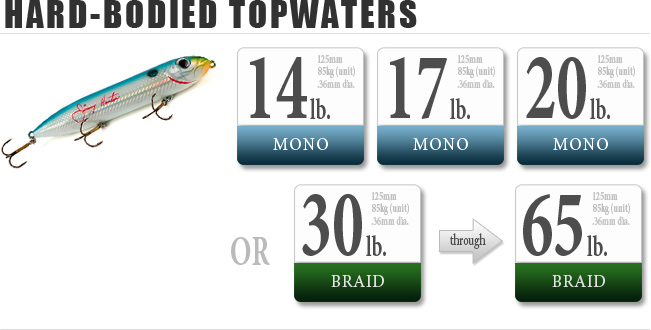
Never use fluorocarbon!
Fluorocarbon sinks and will cause the action of the your baits to suffer tremendously. It’s extremely difficult to twitch a line that is completely underwater.
Why such heavy line?
Because hardly any line is underwater during the presentation, you can get away with much heavier lines with topwaters. Also, the heavy line helps keep the line floating and the baits riding higher in the water column. Mono is the no-brainer line for hard bodied topwaters. Feel free to use braid too if you are using a soft-action rod (like a composite rod). Many pro’s are switching to braid with composite/fiberglass rods for topwaters.
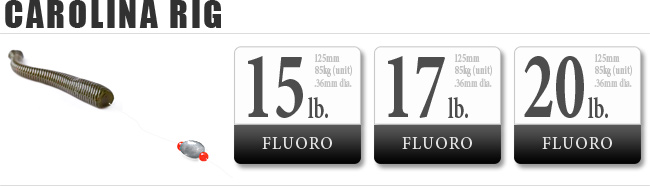
Can I use braid as the main line?
Absolutely, and it’s quite popular to use braid as your main line. Braid has no stretch and will give you better feel of the bottom… A BIG PLUS when fishing a carolina rig. But you can certainly use fluorocarbon as your main line too. A few pro’s don’t like using braid as their main line because they think it can snap their fluorocarbon leaders, but most pro’s it seems, don’t have a problem with braid main lines.
But doesn’t fluorocarbon sink? My bait won’t float!
You’re absolutely right. You’re bait won’t float that great when using fluorocarbon as your leader. But most baits don’t float anyway even with mono as the leader. You’re generally dragging your baits on the bottom either way, so might as well go with line that is less visible and more abrasion-resistant.
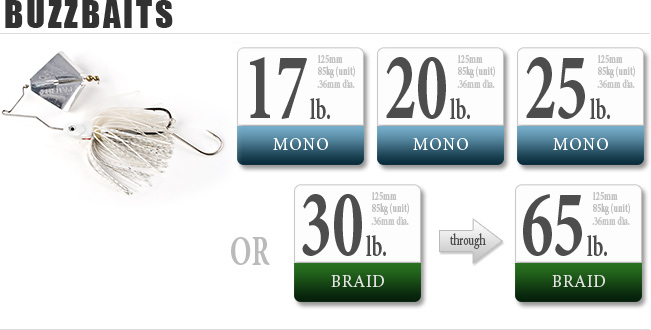
Again, why such heavy line?
Hardly any of your line will be underwater, so you can get away with it. But the real reason to have heavy line is so you have the added buoyancy that a thick mono can give you, and you can really slow your buzzbait down to a crawl, which is often most effective. We especially like using braid for buzzbaits because of the rock-solid hooksets.
And I should never use fluorocarbon, right?
Right. Say no to fluoro. It sinks!
Get better action with fluorocarbon:
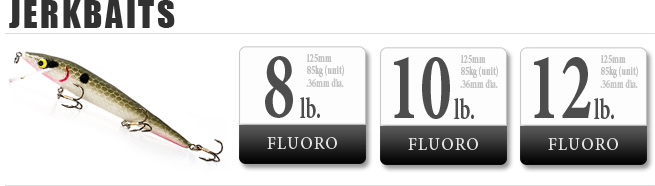
You will get much better action out of your jerkbaits with fluorocarbon line because it sinks. Because it sinks, you’re line won’t have as big a “bow” in it, and it will be a much straighter and direct line from the rod tip to the lure. Thus, when you go to snap your jerkbait, that lure will really rip.
Working jerkbaits near the surface?
If you want to work your jerkbait right under the surface (or even twitch it on top), then monofilament will be your better choice. It’s buoyancy will help in that presentation.
How do I know when to use braid and when to use fluorocarbon?
A lot of factors go into determining when one should choose to fish standard jigs on fluoro or braid. If you are fishing in light cover, clear water, or rocky terrain, generally fluorocarbon is the better choice because it’s less visible, highly abrasion-resistant around sharp objects like rocks, and still has low-stretch for good hooksets and feel.
If you are fishing thick cover or stained and muddy water, braid is generally your best choice. You can get away with visible lines in thick enough cover, and nothing beats braid when it comes to pulling fish out of heavy cover, especially thick weeds. Braid will cut right through that stuff.
Should I use the lower-end or upper-end of the lb. test recommendations?
Base that decision on how thick the cover is. The lighter the cover, the lighter the line. The thicker the cover, the thicker the line. Don’t really know? Go somewhere in between.
Isn’t this kinda light line for jig fishing?
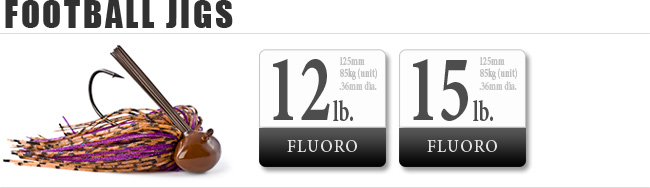
You really have two things that shape the 12 and 15 lb test recommendations for football jigs. The first is visibility. You’re generally dealing with open water, and in most cases, it’s clear. So you have to be cognizant to use line that isn’t too visible.
The second factor, and the most important of the two, is keeping your bait on the bottom. You’re going to be fishing in water 10 feet and deeper most of the time with a football jig. And using anything heavier than 12 or 15 lb. test will make it very hard for your to keep the bait near or on the bottom. Heavier lines will want to pick the bait up because of its water resistance. Fluorocarbon certainly helps because it sinks, but you are keeping a tight line most of the time when fishing a football jig, so you really can’t go much heavier than 15 lb. test.
Large spectrum of strength lines to choose from:
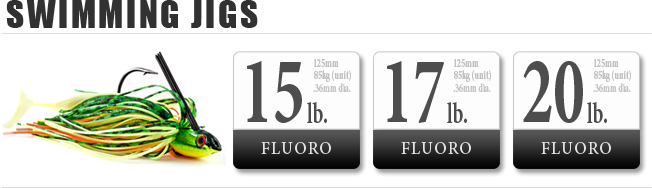
With swimming jigs, you have a bit more wiggle room as to the lb. test you can choose to fish. Base your choice on how heavy of cover you will be fishing.
What if I want to keep it up near the surface?
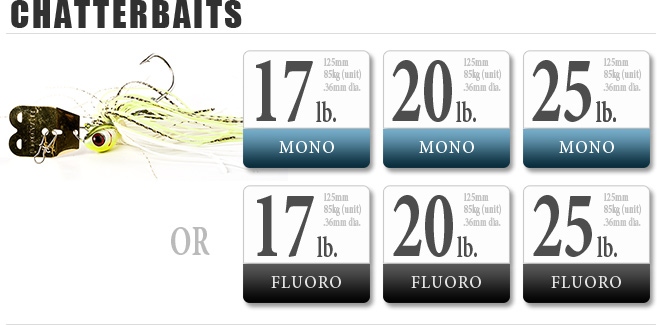
Generally, swimming jigs are most effective when they are retrieved very quickly, so keeping it up near the surface with 17 or 20 lb. test fluoro isn’t too difficult. But if you plan on working it right near the surface all day long, then mono would be the better choice for that scenario.
Why not braid?
You don’t want to use braid for chatterbaits either because it’s more visible underwater. Since the hooks are exposed on a chatterbait, you can get away with the stretch of monofilament or fluorocarbon. If you are trying to keep the chatterbait up near the surface and you’re using fluorocarbon, you’ll need to use a “high tip”, which isn’t an ideal position for hook sets. If the water is heavily-stained or you’re dealing with heavy cover, then you can get away with braid.
Fluorocarbon will help you fish faster:
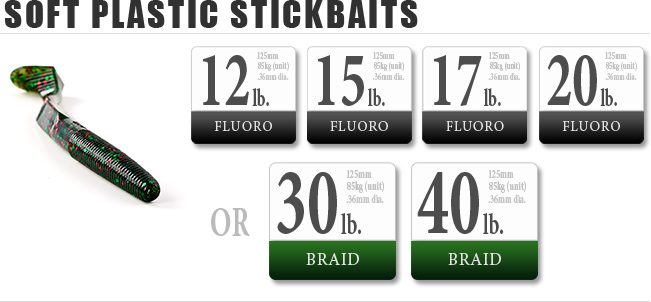
Because fluorocarbon sinks quickly, soft stickbaits will fall much faster and let you work the water column more efficiently and cover more water, while maintaining the action of the bait and having the added benefit of a less visible line.
Aren’t soft stickbaits a finesse tactic? Why not 6 or 8 lb test?
A lot of people think stickbaits are finesse, but they really aren’t. They’re thick baits that fall pretty quick on a long line. Since most anglers texas rig these baits (or tex-pose, which we prefer), you need the added strength for the hookset. Eight pound test would get you in trouble a lot.
When should I go with braid?
Braid is the excellent choice when fishing thick grass or weeds. You can get away with braid around thick grass and braid slices right through the weeds when you are battling big fish. Braid is your buddy when fishing thick grass with soft stickbaits.
Should I stick with the heavier lines here?
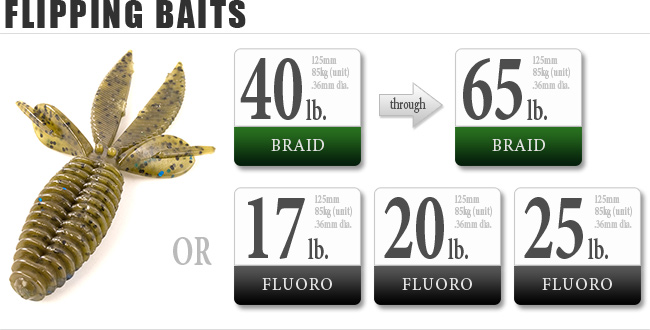
Absolutely. Flipping baits are synonymous with thick cover, so favor the upper-end of the line sizes in the ranges we recommend. You need the power to set the hook, get the fish moving out of the cover, and to flip them in the boat. You need strength and power.
Is there a preference for braid?
We think there should be a slight preference for braid in most circumstances for flipping baits. Thick cover lends itself to the fact that you can get away with very heavy line without spooking fish. And nothing is more important than knowing you can get the fish out of thick brush or weeds the moment after you set the hook. Braid on a flipping reel is a powerful winch that big bass can’t contend with. This is exactly what you are looking for with these baits. But fluorocarbon is a perfectly fine choice too.
Low-Visibility and Low-Stretch is the name of the game:
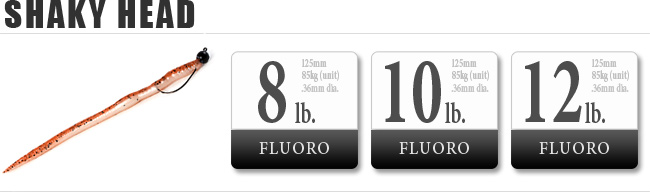
The shaky head is a finesse technique when you are required to slow down and pick apart a smaller area. If there was one technique that fluorocarbon was made for, it’s shaky head fishing. Base your line size choice on two factors, how thick the cover is, and how clear the water is.
I know braid is a bad choice, but why not mono?
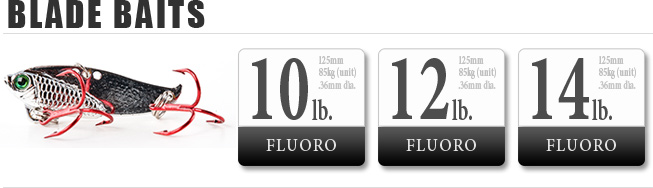
These small blade baits are generally used during the winter months when bass sit in deeper water drop offs and ledges and become extremely inactive. Because bass are so lethargic, feeling bites can be nearly impossible because the fish suck in the lures so lightly. Because fluorocarbon has a lot less stretch than mono, it will help you detect these very light bites. Again, fluorocarbon is far less visible, and with these vertical jigging techniques, the bass will be getting a good look at your baits because you are working them a lot in one small area. The less visible lines will benefit you greatly.
Why not go lighter with 6 or 8 lb test if the bass are so finicky?
Here at BassFishin.Com, we think these small blade baits are “big fish” baits. Though you don’t catch many in the winter, what you do catch will often be very big since the small fish don’t group up with the big fish as much in the colder season. Ten to 14 lb. test is the perfect choice for getting the action you want out of the bait and having the strength to handle any size fish with confidence.